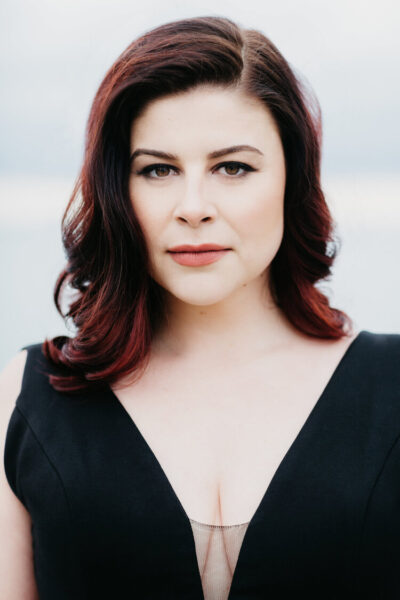
“Amado enlisted acclaimed American soprano Mary Wilson for these iconic songs, a touchstone for singers. Surprisingly, this was Wilson’s first time performing them, something certainly not apparent in her radiant and rich interpretation.
Wilson rose to the vocal and dramatic challenges of this demanding work — not really a soprano solo with accompaniment, but a duet (almost a concerto)… she sang with perfect poise, ever-unfolding depth, and admirable vocal restraint, never attempting to dominate — something that might tempt a lesser artist.” —Broad Street Review on Strauss’ Four Last Songs with Delaware Symphony Orchestra
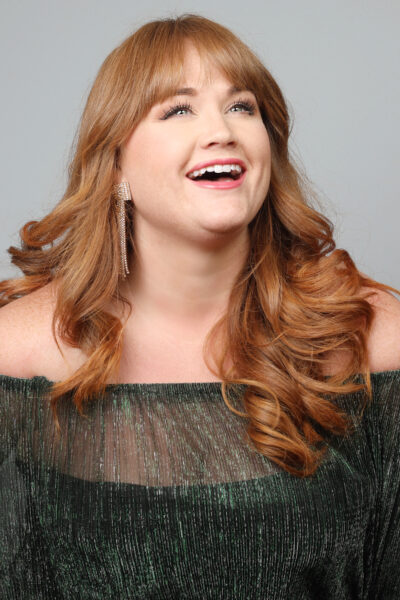
| Mary’s love for oratorio is always at the forefront. She created a graduate level class in oratorio, where students both sing the repertoire and learn that it is a vibrant and thriving art form. She has also started working on a singer’s guidebook for oratorio performance. “I’ve always been attracted and “I am preaching the gospel of oratorio wherever I go,” says Athlone Artists’ newest roster member, soprano Mary Wilson. Known for a voice that is both “lyrical and triumphant, a dazzling array of legato melodies and ornate coloratura” (San Francisco Chronicle) and “crystal clear and agile” (Early Music America), Mary is enjoying a thriving career as a concert soloist, operatic soprano, recording artist, and educator. She is also the Co-Founder and Director of the newly minted Bach Festival Society of Winter Park American National Oratorio Competition for young American singers specializing in the genre, which kicked off in February of this year. And in 2024, Mary was named the First Place Winner of The American Prize in Vocal Performance Art Song and Oratorio Division, The Friedrich and Virginia Schorr Memorial Awards, to “recognize and reward the best performances by classically trained vocalists in America.” “I am one of the crazies that was raised on music,” Mary says with a grin. “My dad is a high school choir director, and my mom was a piano teacher, so I knew how to read music before I could read my ABC’s.” She studied piano with her mother and singing with her father, and enjoyed performing in the church and school choirs in her hometown of Rosemount, Minnesota. When she was admitted into the vocal performance program at Minnesota’s St. Olaf College – with its internationally renowned choir – she readily accepted. It wasn’t until she was at St. Olaf that she discovered how much she enjoyed singing as a soloist. She says, “When you go to college, you take a voice lesson and you think, ‘This is awesome.’ And you want to learn more and more. And I’ve been going down that rabbit hole ever since!” Mary found her niche singing concert repertoire and oratorio. “I think the reason I am so drawn to oratorio is because it still has that choral connection – that corporate connection. All three hundred people taking the same breath together. It is really fulfilling.” When she completed her undergraduate degree, Mary was accepted into the New England Conservatory in Boston. After one year, however, she realized that it wasn’t the right place or time for her. “I just wasn’t quite ready,” she says. After heading home for a while, Mary decided it was time for a change, and on a whim, she and her husband moved to St. Louis, Missouri, where she considered seeking a law degree. Little did she know it would prove to be the launching point of her musical career. Mary joined a church choir, while working in a law office by day. “I was never away from music, but I wasn’t pursuing it,” she says. Then one day, after a church service, she was approached by a voice teacher, tenor John Stewart, who was a professor at Washington University. He encouraged her to continue her studies, and she soon found herself enrolled in the master’s degree program in vocal performance under his tutelage. “He really changed my life,” says Mary about Stewart. “He helped me find a really natural technique.” Shortly thereafter, Mary was named a national finalist in the Metropolitan Opera National Council Auditions, and was invited to be an Adams Fellow at the Carmel Bach Festival. She beams: “And I haven’t stopped, since!” Mary’s concert career has taken her to stages across the world, including appearances with the Symphony Orchestras of Boston, Cleveland, Cincinnati, Detroit, Philadelphia, Costa Rica, and Singapore, the Los Angeles Philharmonic; the St. Paul Chamber Orchestra, and at Carnegie Hall and the Hollywood Bowl. She has frequently worked with conductors Jeffrey Thomas, Nicholas McGegan, Martin Pearlman, Martin Haselböck, Robert Moody, Carl St. Clair, JoAnn Falletta, Giancarlo Guerrero, John Sinclair, Anton Armstrong, and Leonard Slatkin. Along with a robust concert schedule, Mary’s opera career has also blossomed, and she has enjoyed portraying Zerbinetta in Ariadne auf Naxos, Susanna in Le Nozze di Figaro, and Gilda in Rigoletto; and creating leading roles in North American and world premiere performances of Dove’s Flight, Glass’ Galileo Galilei, and Petitgirard’s Joseph Merrick dit L’Elephant Man. Mary also relishes her opportunities to sing art song, and to record for her growing discography. With the IRIS Chamber Orchestra in Memphis, Wilson sang the world premiere of the song cycle “Songs Old and New” written especially for her by Ned Rorem. Opera News dubbed her first solo recording, Mary Wilson Sings Handel one of their “Best of the Year,” stating: “Wilson’s luminous voice contains so much charisma.” “I’ve been able to explore more and more repertoire,” she says. “I feel so blessed because I’ve had a foot in the modern world, and a foot in the historical orchestra world.” Although Mary’s vocal bucket list includes Britten’s War Requiem, and reprising her role as soloist in Beethoven’s Missa Solemnis, Strauss’ Four Last Songs, and “as much Mahler as I can sing before I die,” Mary will forever keep her heart open to the music of the Baroque. “I’ve always said that Handel is my boyfriend,” she laughs. “I’ve never heard anything Handel that I don’t like. Handel makes sense to me. I’ve become a Baroque specialist, because that’s where I was getting jobs. Now that my voice is fuller, I’ve gotten to sing all of this Beethoven and Mahler. I’ve tapped into a part of myself that is a full body singing, and it’s exciting. But I am always keeping the flexibility to sing Handel, Bach, and Mozart.” In between performances, Mary keeps busy sharing her love of music with future generations as a Professor of Voice and the Vocal Area Coordinator at the University of Memphis; a voice faculty member and leader of the Teaching Fellowship Program for the Institute of Performing Arts International in Kiefersfelden, Germany; and as a mother – her son is a senior in high school currently looking into further music education as a trombonist. Mary’s love for oratorio is always at the forefront. She created a graduate level class in oratorio, where students both sing the repertoire and learn that it is a vibrant and thriving art form. She has also started working on a singer’s guidebook for oratorio performance. “I’ve always been attracted and drawn to the solo, choral, and orchestral repertoire. We are somehow taught that we cannot sing with our full voices when we sing oratorio, and it is my job to give singers the chance and the permission to be as dramatic in this music as you would in any other opera aria. There might be ornamentation and rules, but there is also permission to play. We must use our whole selves to tell the story.” This spring, Mary was heard singing Strauss’ Four Last Songs with the Alabama Symphony, Mozart’s Requiem with the Rochester Philharmonic, and Mahler’s Symphony No. 8 “Symphony of a Thousand” with Giancarlo Guerrero and the Nashville Symphony. |